Strategic Growth Without the Headcount: Leveraging Fractional Sales Talent in the B2B Sector
The business-to-business (B2B) sales environment has undergone a profound structural transformation, rendering traditional growth playbooks largely obsolete for small and medium-sized businesses (SMBs). Organizations operating in the mid-market and SME sectors confront a convergence of challenging market forces: lengthening sales cycles, expansive buying committees, and a severe decline in overall sales productivity. As the modern buyer's journey becomes increasingly self-directed and digital-first, the conventional methodology of scaling revenue by simply adding more full-time, in-house sales headcount has proven to be financially inefficient and operationally sluggish. In response to these pressures, a paradigm shift is occurring in how organizations acquire and deploy sales talent.
The fractional work model has evolved into a mainstream, $5.7 billion global economic force, growing at an annual rate of 14 percent. The number of fractional professionals doubled from 60,000 in 2022 to 120,000 in 2024, with fractional sales leadership specifically seeing an 80 percent surge. This evolution allows B2B organizations to access elite, veteran sales expertise and specialized execution teams on a flexible, part-time, or retainer basis.
Velocity Partners Group observes this shift not merely as a cost-containment strategy, but as a critical competitive advantage. A robust growth architecture requires the seamless alignment of finance, marketing, technology, and sales. The deployment of fractional sales professionals perfectly complements this cross-functional ecosystem, delivering capital-efficient growth that allows SMBs to punch above their weight class. By decoupling executive-level strategy and high-volume prospecting from the rigid burdens of W-2 employment, businesses are dramatically reducing overhead, accelerating their time-to-market, and achieving superior returns.
The Crisis of the Traditional In-House Sales Model
To understand the explosive adoption of fractional sales models, it is essential to examine the systemic failures of the traditional in-house sales structure. In the current economic climate, B2B sales teams face an unprecedented quota attainment crisis. Recent benchmark data reveals that a staggering 84 percent of sales representatives missed their quotas in recent tracking periods, representing a catastrophic decline from historical norms.
The modern B2B purchasing decision is highly complex. The average buying committee now involves multiple stakeholders, pushing the average B2B sales cycle to 6.5 months generally, and up to 14.7 months in highly regulated sectors. Buyers are heavily reliant on digital self-education, with 81 percent identifying a preferred vendor before ever speaking to a sales representative. Consequently, traditional outbound strategies that rely on uncalibrated volume are experiencing diminishing returns, with general B2B win rates compressing to the 17 to 21 percent range.
Compounding these external challenges is a severe internal productivity paradox. Despite vast investments in sales enablement technology, internal sales representatives spend an average of just 28 to 35 percent of their actual working hours engaged in revenue-generating selling activities. The traditional employment model also introduces immense financial friction. The annual turnover rate for B2B sales roles averages 35 percent, and the cost of a poor sales hire is estimated at $240,000 when factoring in salary, benefits, training, and the severe opportunity cost of lost pipeline generation. Treating sales talent strictly as a fixed, internal asset leaves SMBs highly vulnerable to these inefficiencies.
The Economics of Outsourced Talent
The primary catalyst driving SMBs toward fractional sales models is the stark contrast in the Total Cost of Ownership (TCO) when compared to traditional W-2 employment. The true financial burden of an internal hire dramatically exceeds their base salary, heavily skewing the unit economics of early-stage and mid-market growth.
Acquiring a full-time, experienced Vice President (VP) of Sales requires a massive capital commitment. In the current market, a competent full-time sales executive commands a base salary between $180,000 and $250,000. However, the base salary represents only 60 to 70 percent of total compensation. When an organization factors in performance bonuses, equity dilution, employer taxes, healthcare benefits, and recruitment search fees, the first-year cash outlay for a senior full-time hire routinely approaches $300,000 to $450,000.
Conversely, a fractional sales leader operates on a flexible retainer model. Depending on the exact scope of the engagement, fractional sales executives typically charge between $6,000 and $12,000 per month, translating to an annual cost of roughly $80,000 to $150,000. Because the fractional executive is an independent contractor, the host organization incurs absolutely zero expenses related to benefits, payroll taxes, equity, or severance packages. This paradigm represents a 50 to 70 percent reduction in executive leadership costs, instantly preserving runway.
Fractional Models Reduce Total Cost of Ownership by Up to 64%
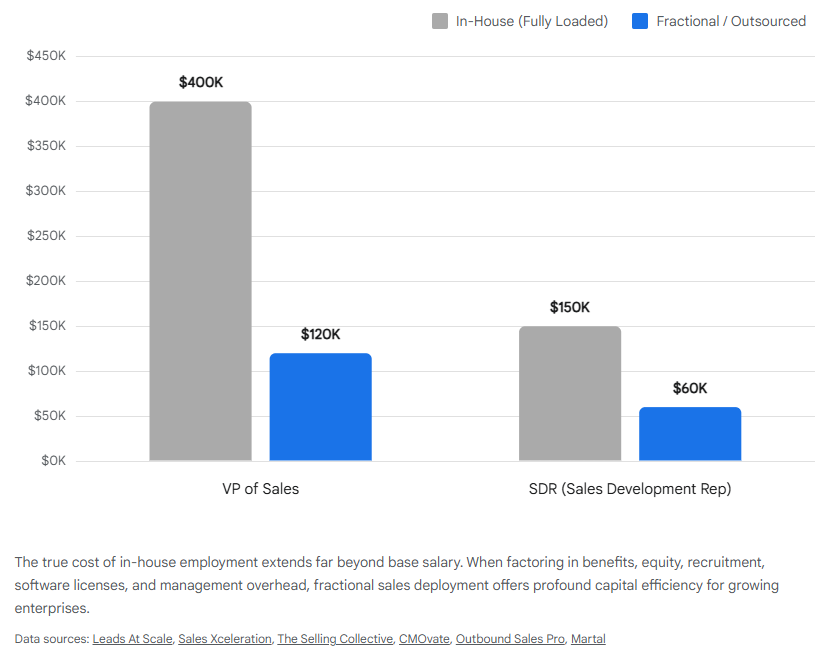
The financial disparity is equally pronounced at the execution tier, specifically concerning Sales Development Representatives (SDRs).
| Cost Component | In-House SDR (Fully Loaded) | Outsourced / Fractional SDR |
|---|---|---|
| Base Compensation | $50,000 - $65,000 | N/A (included in retainer) |
| Employer Burden & Benefits | 25% - 35% of Base | $0 |
| Technology & Data Stack | $5,000+ | Included |
| Recruitment & Training | $5,500 - $9,500 | $0 |
| Total Annual Investment | $125,000 - $150,000 | $42,000 - $70,000 |
Analysis based on aggregated industry benchmarks.
By leveraging economies of scale, shared technology stacks, and optimized management hierarchies, specialized SDR agencies provide dedicated pipeline generation for a fraction of the internal cost, cutting top-of-funnel sales costs by an average of 40 to 64.8 percent.
Operational Velocity and Accelerated Pipeline Generation
While cost containment is a highly visible benefit, the true strategic advantage of fractional sales talent lies in operational velocity. The traditional process of building a sales infrastructure is inherently sluggish. The recruitment cycle for a senior sales executive often consumes 60 to 90 days, followed by an additional three to six months of onboarding before their initiatives yield measurable pipeline growth.
The friction is even more severe at the SDR level. Due to the complexities of modern B2B offerings, the average time required for an in-house B2B SaaS sales representative to achieve full quota productivity has ballooned to 5.7 months in 2025. During this prolonged ramp phase, the organization absorbs maximum financial burn while extracting minimum revenue output.
Outsourced Teams Generate Pipeline 3x Faster Than Internal Hires
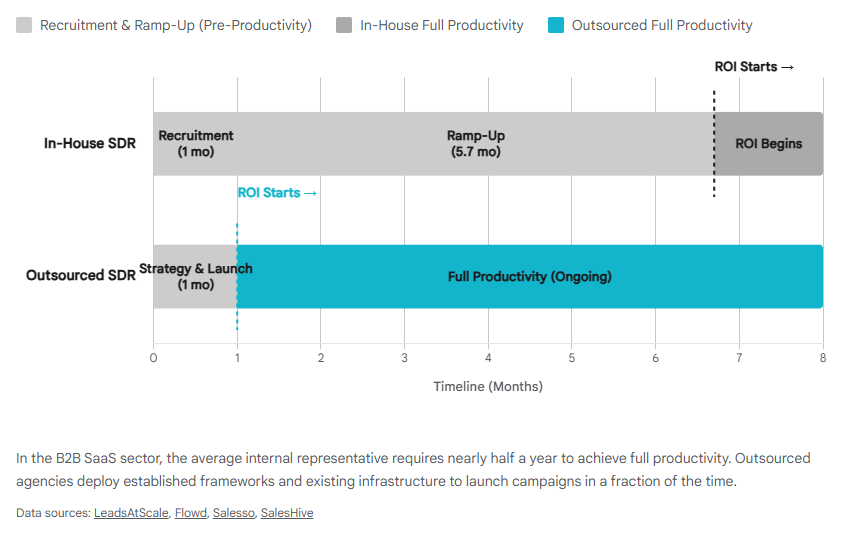
Fractional sales models effectively bypass this latency. Fractional executives possess decades of pattern recognition and arrive with pre-configured playbooks and established operational frameworks, compressing their time-to-impact. Organizations utilizing fractional sales leaders report reducing their planning-to-execution timelines by over 50 percent. Similarly, outsourced SDR agencies operate as turnkey pipeline generation facilities, capable of launching sophisticated, multi-channel outbound campaigns in just two to four weeks. This allows an organization to add pipeline capacity two to three times faster than navigating the internal recruitment gauntlet.
Industry Applications and Performance Outcomes
The efficacy of fractional sales is consistently validated across highly complex B2B sectors. When organizations inject senior-level fractional expertise into their sales operations, structural improvements compound rapidly, yielding an average revenue increase of 24 to 32 percent within the first year of engagement.
Software-as-a-Service (SaaS)
The SaaS sector demands extreme capital efficiency, particularly concerning Customer Acquisition Cost (CAC). SaaS businesses frequently encounter growth plateaus where founder-led sales motions run out of momentum. Fractional sales leadership provides these firms with the specialized knowledge required to establish Product-Led Growth (PLG) strategies and optimize retention metrics without the overhead of a full-time executive. For example, a B2B software company that plateaued at $3 million in revenue engaged a fractional VP of Sales for $8,000 per month. Over eight months, the fractional leader implemented a robust CRM architecture and established a repeatable go-to-market motion, resulting in 65 percent revenue expansion to $4.95 million—a 2,437 percent return on the fractional investment.
Specialized Manufacturing
Manufacturing firms frequently exhibit deep expertise in product engineering but possess critical vulnerabilities in proactive sales, often relying entirely on localized networks and word-of-mouth referrals. Fractional sales executives provide these organizations with modern, data-driven revenue frameworks that align commercial strategy directly with supply chain and operations planning (S&OP). This model is highly effective for market expansion. A specialized manufacturing services firm seeking to enter the highly regulated healthcare sector engaged an industry-specialist fractional sales consultant. Rather than risking a full-time hire in an unproven vertical, the firm invested $72,000 in a six-month project. Within 18 months, the firm generated $2.1 million in new revenue from the healthcare vertical, representing a 2,917 percent ROI.
Professional Services
In professional services, revenue generation is traditionally driven by founding partners. As these firms scale, partners become bottlenecks between client delivery and business development. Fractional sales leadership de-risks this transition by installing repeatable sales playbooks that exist independently of the founders. Velocity Partners Group frequently guides service firms through these evolutions. Instances such as DKB Consulting seamlessly launching a Managed Service Provider (MSP) division, or Wall Consulting Group expanding its service lines, highlight how a fractional growth partner acts as an architectural bridge. Furthermore, when Linguava Interpreters faced stagnant turnover, the implementation of a fractional sales consultant culminated in the firm achieving $1 million in monthly revenue, a 20 percent growth milestone.
Strategic Execution: The Velocity Partners Group Approach
While the underlying mathematics of fractional sales are highly favorable, realizing the full potential of the model requires disciplined execution. Treating a fractional sales leader or an outsourced SDR team as a disconnected vendor is a primary cause of engagement failure. To succeed, the fractional talent must be deeply integrated into the host organization’s operations.
Velocity Partners Group champions a methodology where sustainable growth is achieved through a cross-functional stack, perfectly synchronizing financial capital, marketing strategy, technological infrastructure, and sales execution. Before outbound execution begins, comprehensive diagnostic assessments are required to refine the Ideal Customer Profile, map the buyer's journey, and establish transparent KPIs. Furthermore, operating on flexible, short-run tactics without long-term contractual lock-ins ensures alignment with a client's financial realities, functionally eliminating the risk profile for the SMB. This creates an environment of total accountability, incentivizing the delivery of actionable pipeline and measurable revenue outcomes.
By providing on-demand access to seasoned strategists and elite, technology-enabled prospecting teams, the fractional model strips away the bloated overhead of traditional employment. It offers SMBs the agility to scale operations instantaneously and the specialized expertise necessary to break through revenue plateaus, proving to be the definitive architecture for modern, profitable growth.